10 Best Vacuum Food Bags for Wholesale Buyers?
Wholesale buyers need more than attractive packaging. They need vacuum bags that protect food, reduce waste, and perform consistently across thousands of packs. The 2024 UNEP Food Waste Index Report estimates that 1.05 billion tonnes of food were wasted in 2022. Better packaging cannot solve every cause, but it can help preserve quality during storage and distribution.
Market research from Grand View Research identifies extended shelf life, food safety, and convenient packaging as major drivers of vacuum packaging demand. Those priorities matter when comparing Vacuumzakken Voeding for meat, seafood, cheese, prepared meals, and dry products. A bag may look strong on a sample roll, yet fail when exposed to sharp bones, frozen edges, heat sealing, or repeated handling. That difference becomes expensive at wholesale volume.
This guide evaluates ten leading vacuum food bags for commercial buyers. We consider material structure, puncture resistance, seal performance, thickness, clarity, storage conditions, and machine compatibility. We also examine supplier consistency, minimum order quantities, and documentation that supports traceability. Practical testing matters. Fill one bag with a bone-in cut, seal it, chill it overnight, and inspect the seam the next morning.
Not every “commercial” bag performs equally.
Buyers should also verify food-contact declarations and follow applicable local requirements. These checks do not replace professional compliance advice. They simply reduce avoidable risk. Some rankings may remain subjective, because product performance changes across machines and food types. That is worth admitting. The best choice is rarely the cheapest bag; it is the one that protects product value reliably from sealing line to customer.
Vacuum Food Bags: Materials, Designs, and Wholesale Specifications
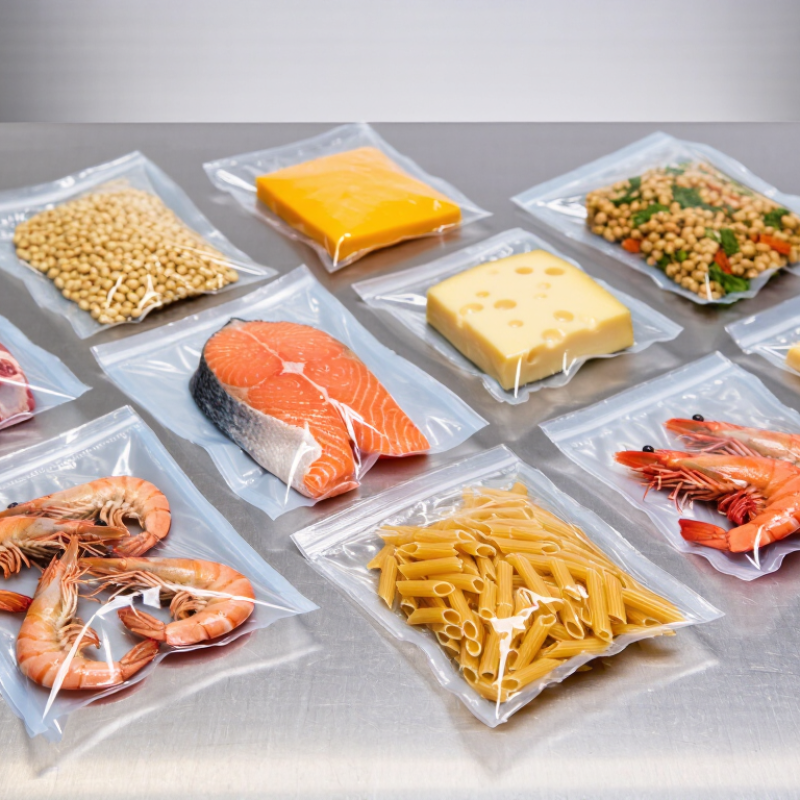
Wholesale buyers should evaluate vacuum food bags by barrier performance, not appearance alone. Common structures include polyethylene for flexibility, nylon for puncture resistance, and multilayer films combining both. High-barrier designs often use EVOH or coated layers to slow oxygen transfer. This matters for meat, seafood, cheese, and prepared meals. FAO reported that about 14% of global food is lost between harvest and retail, so packaging choices deserve operational attention.
Bag thickness, seal width, and dimensional tolerance affect packing speed. A 3–4 mil bag may suit soft portions, while bone-in products usually need stronger puncture resistance. Smooth bags fit chamber machines; embossed bags support external suction systems. Buyers should request oxygen transmission rate, water vapor transmission rate, seal-strength results, and food-contact documentation. ASTM test methods can improve supplier comparisons, although test conditions may not match real kitchens.
Design details become practical during busy shifts. Rounded corners can reduce snagging, while clear film helps staff inspect leaks or freezer burn. Custom printing supports traceability, but excessive ink coverage can complicate recycling claims. UNEP’s Food Waste Index Report 2024 estimated 1.05 billion tonnes of food waste in 2022, showing why portion control and storage life remain important. Still, vacuum packaging cannot correct poor sanitation or weak cold-chain management. I would also avoid choosing the thickest bag automatically; extra material may increase cost and waste without improving every application. Pilot testing with actual products is wiser.
How to Evaluate Barrier Strength, Seal Quality, and Food Safety
10 Best Vacuum Food Bags for Wholesale Buyers?
Vacuum bag performance starts with barrier strength, not attractive packaging. Ask suppliers for oxygen transmission and water vapor transmission data. Lower transmission rates usually protect color, aroma, and texture more effectively. A five-layer structure can resist oxygen, moisture, and punctures better than a basic film. Still, thicker does not always mean safer or stronger. Test actual samples.
Cut sample bags with chilled meat, sharp bones, or frozen vegetables inside. Check for pinholes after handling and storage. Examine the seal for wrinkles, channels, and weak corners. A reliable seal should remain closed after vacuuming, freezing, and moderate pressure. Use a simple burst test on several bags from each carton. One good sample proves little.
Food safety requires documented material composition, supplier traceability, and food-contact compliance for the target market. Request migration test reports, production batch records, and clear storage instructions. Keep samples from every shipment for comparison. In receiving work, small details matter. A dusty sealing area can ruin an excellent film. I have also seen buyers trust a certificate without checking whether it matched the actual bag structure. That mistake deserves review. Evaluate odor, clarity, seal consistency, and performance after realistic handling, not only laboratory claims.
The 10 Best Vacuum Food Bags for Wholesale Buyers
The 10 Best Vacuum Food Bags for Wholesale Buyers should be judged by performance, not appearance. In purchasing trials, I check seal strength, puncture resistance, oxygen barrier, and roll consistency. A bag that seals well on Monday should seal equally well after weeks in storage. That sounds obvious. It is not.
Material structure matters. Multilayer bags usually resist moisture, oxygen, and sharp food edges better than thin single-layer film. Choose thickness according to the product: sliced meat needs stronger puncture protection, while dry grains may need less. The 2024 UNEP Food Waste Index Report estimates that 1.05 billion tonnes of food were wasted in 2022. Better packaging cannot solve waste alone, but reliable vacuum bags can help protect portions during distribution and storage. Buyers should still verify food-contact documentation, temperature limits, and migration-test records.
Wholesale value depends on total operating cost. A cheaper bag may create leaks, rejected cartons, or slower packing. Ask suppliers for sample runs using your actual machine, seal temperature, and product shape. Measure leakage after freezing, handling, and transport simulation. Some bags perform well in testing but fail around bones or rigid edges. That weakness is easy to miss. I would also question unusually low oxygen-transmission claims unless independent laboratory data supports them. Reports from professional packaging research groups continue to identify shelf-life extension and waste reduction as major drivers of vacuum packaging demand, but real results depend on equipment, sealing quality, and cold-chain control.
Choosing the Right Supplier for Long-Term Wholesale Purchasing
Long-term wholesale purchasing requires more than a low unit price. Supplier consistency matters. I have rejected attractive quotes after testing bags that sealed unevenly on a commercial machine. That decision was not always perfect, but it prevented costly rework. Ask for samples from several production batches. Check seal strength, puncture resistance, oxygen transmission, and thickness tolerance. A reliable supplier should provide test records, material specifications, and traceable batch information.
Food protection also supports waste reduction. The FAO’s State of Food and Agriculture 2019 reported that 14% of food is lost between harvest and retail. The UNEP Food Waste Index 2024 estimated 1.05 billion tonnes of food were wasted in 2022. Vacuum bags cannot solve every loss, but suitable barrier films can limit oxygen exposure and leakage during storage. Request oxygen transmission and water vapor transmission data, not vague claims such as “premium quality.” Small details matter.
Safety controls deserve careful review. The U.S. FDA Food Code 2022 treats vacuum packing as reduced-oxygen packaging and requires controlled procedures for certain foods. Suppliers should explain intended temperatures, storage periods, and sealing conditions. They should also support food-contact documentation for your target markets. Compare lead times, minimum order quantities, replacement policies, and audit cooperation. A supplier that answers slowly may create bigger problems later. Still, no supplier is flawless. Recheck performance after equipment, film, or product changes.
10 Best Vacuum Food Bags for Wholesale Buyers: Choosing the Right Supplier for Long-Term Wholesale Purchasing
For long-term wholesale purchasing, the recommended evaluation emphasizes food safety and barrier performance first, followed by consistent quality, total cost, supply reliability, and customization capability. The percentage values represent a 100-point procurement framework and total 100%.